Skip to content

This weekend: CRSSD Fall · Sat Doors noon both days · Tickets on sale

The San Diego List*
WEEKEND
Things to Do · Itineraries

The Perfect 5-Day San Diego Itinerary

Five days by area: sea lions at La Jolla Cove, Old Town's adobes, Cabrillo's lighthouse, Chicano Park's murals, the Coronado ferry and a COASTER day.

14 stopsCopy updated Sep 23, 2026Sources checked Aug 2, 2026By The San Diego List

The short answer

The best 5-day San Diego itinerary groups each day by area.

Day one: the La Jolla coast and Mission Bay, plus Torrey Pines once the reserve reopens (planned for March 2027). Day two: Old Town, Liberty Station, Cabrillo and Sunset Cliffs. Day three: Balboa Park, North Park and Little Italy. Day four: Chicano Park in Barrio Logan, the USS Midway and the Coronado ferry. Day five: a North County COASTER trip or dinner on Convoy. A car makes the coast and Point Loma days easiest.

NeighborhoodsLa Jolla →Torrey Pines →Mission Beach →Point Loma →Midway District & Liberty Station →Old Town →Balboa ParkNorth Park →Little Italy →Barrio Logan →Downtown →Coronado →Oceanside →Santee →Convoy District →

Five days is when San Diego starts to make sense. A weekend gets you the postcard. Five days shows you how the pieces fit together: a plaza whose story starts with a Kumeyaay village, a Navy boot camp turned arts district, a park dressed up for a 1915 world's fair, murals painted on the columns under the Coronado Bridge, and a commuter train that runs up the coast to Oceanside in about an hour.

This plan covers all of that in 14 stops, grouped so no day crosses the whole county. Day one stays on the north coast around La Jolla and Mission Bay. Day two runs from Old Town through Liberty Station to Cabrillo and Sunset Cliffs on Point Loma. Balboa Park, North Park and Little Italy share day three. Day four takes in Barrio Logan, the USS Midway and Coronado. Day five is your call: one North County town by train or car, or an inland dinner on Convoy Street. The order is the route itself, built around what opens when.

A few things before you book. A car saves real time on the coast and Point Loma days. Without one, stay Downtown or in Little Italy and lean on the harbor, the ferry, Balboa Park and a COASTER day. Decide early which big attraction owns each day, the Zoo or a Balboa Park museum, the Midway or a long Coronado afternoon, because trying to do both is how a good day gets rushed. And note the fall 2026 news: Torrey Pines State Natural Reserve is closed for construction until a planned March 2027 reopening, so day one starts in La Jolla for now.

Short on time? The 3-day itinerary covers the essentials, and our guides to San Diego without a car and where to stay help you set up the week.

Before you go

Check these before you lock in a day

A few parts of this route run on fixed or changing schedules: the Cabrillo gate, the last ferry back from Coronado, sunset at Sunset Cliffs, wildlife closures along the La Jolla shoreline, and the COASTER timetable. The Torrey Pines reserve is also closed for construction until a planned March 2027 reopening. Check each one for your dates before you build a day around it.

Torrey Pines reserve hike

DAY 1 · ROUTE BLOCK
The move
Pick one trail, like the short Guy Fleming loop, and go early. Until the reserve reopens, walk Torrey Pines State Beach instead.

The rarest pine in the country grows on the sandstone bluffs of Torrey Pines State Natural Reserve, which carries a La Jolla address and a landscape all its own. A morning hike here is how this five-day trip is meant to begin, with one big caveat for fall 2026 that's covered below.

The torrey pine grows naturally in just two places: this reserve and Santa Rosa Island, off the coast near Santa Barbara. That rarity is why the land has "reserve" status, a label California gives only to parks with threatened species or unusual geology, and only 16 state park units carry it. Even the visitor center has a story. It sits in a pueblo-style building from 1923 that started out as a restaurant.

The reserve opens the trip for a practical reason, too. It's the stop most sensitive to crowds and parking, and the lots can close when they fill on busy weekends, so it gets the early slot before the rest of the coast.

Pick one trail that fits your group and save your legs for La Jolla. The Guy Fleming loop is the short one, winding through the pines and eroded sandstone with bluff and ocean views. Razor Point stays up on the bluffs. The Beach Trail drops to the sand, and a return along the beach only works at a safe low tide. When the reserve is open, it has listed free public nature walks at 10 a.m. on Fridays, weekends and holidays. Restrooms are at the beach lots, the upper reserve has portable toilets, and the visitor center has none.

Now the caveat. California State Parks closed the entire reserve to visitors on September 22, 2026, for construction. That includes every trail, the Beach Trail staircase, the Lodge and both upper parking lots, and the reserve is scheduled to reopen around March 1, 2027. Torrey Pines State Beach and its North Beach and South Beach lots stay open. If your trip lands before the reopening, start the morning on the state beach or head straight to La Jolla Cove, and check State Parks' Torrey Pines page before you drive.

La Jolla public coast walk

DAY 1 · ROUTE BLOCK
The move
Walk the Coast Boulevard path from the Cove past Scripps Park to the Children's Pool overlook, watching wildlife from the path.

After a trail, La Jolla Cove is where the morning slows down. The public path along Coast Boulevard in La Jolla is an easy, paved walk with the Cove below, sea lions on the rocks nearby and the Children's Pool seawall at the far end, and it's on this route because it gives you the coast at walking pace.

The Cove sits inside the San Diego-La Jolla Underwater Park Ecological Reserve. Fishing is off-limits there, and so is taking anything home, shells and stones included. The City calls it one of the most photographed beaches in Southern California, and in calm conditions the water can be clear past 30 feet. The sea lions are a newer part of the scene. Their numbers here grew after the federal Marine Mammal Protection Act of 1972, and in warm months the Cove is known for a strong sea lion smell.

From the Cove, walk south past Scripps Park and Shell Beach to the walkway above Children's Pool. That seawall was built to create a protected swimming cove. Sand has since filled in much of it, and harbor seals use the beach now, so it closes to people from December 15 to May 15 for pupping season. Point La Jolla and Boomer Beach are closed to beach access year-round. Stay on the public path and give every animal plenty of room.

Restrooms, showers and a permanent lifeguard station make the Cove an easy stop after a hike. On-street parking is tight, so going early helps, and steep concrete steps lead down to the Cove beach. With four days still ahead, an hour here is plenty.

Pacific Beach and Mission Bay

DAY 1 · ROUTE BLOCK
The move
Pick one version after checking conditions: a bay bike ride, a picnic, a boardwalk walk to the Giant Dipper, or an official swim area.

Day one's afternoon belongs to Pacific Beach and Mission Bay, where the plan can be as simple as a bike path or a patch of sand. The block sits between the north coast and Point Loma, so it keeps the day moving in one direction.

The bay has a better origin story than most people expect. Until the late 1940s this was False Bay, a shifting mix of lagoons, estuaries and tidal marsh. Crews dredged 25 million cubic yards of sand and silt to shape the islands and coves you see now, working through the 1950s and 1960s, and the result is the largest man-made aquatic park in the country. The City's numbers are big: 4,235 acres, roughly half land and half water, with 27 miles of shoreline, 19 miles of sandy beach, eight official swimming areas and nearly 14 miles of bike paths.

On the ocean side, Ocean Front Walk runs about 3.2 miles from Law Street in Pacific Beach down through Mission Beach. In Mission Beach it passes Belmont Park and the Giant Dipper, a wooden roller coaster that opened on July 4, 1925. It was badly damaged in a 1955 fire, saved from demolition by a local campaign in 1978 and restored in 1989 and 1990, and it's now a National Historic Landmark. It turned 100 in 2025.

The smart move is to pick one version of the afternoon and stay with it: a ride on the bay paths, a picnic and playground stop, a boardwalk walk to the Giant Dipper, or time near one of the official swimming areas. Docks, rentals, courts, restrooms, showers and lifeguards are all here, in designated spots. Parking and boardwalk crowds are what eat into this block, so choose your spot and settle in.

Your next good San Diego plan.
Places to try, weekend ideas and the local updates that change your plans. Join the early list. We’ll email you when the first issue launches.
By subscribing, you agree to receive The Shortlist by email when it launches. Free; unsubscribe anytime. See our privacy policy. Questions about The Shortlist?

Old Town State Historic Park

DAY 2 · ROUTE BLOCK
The move
Walk the plaza and the original adobes, catch the blacksmith shop or a walking tour, then decide on lunch.

Old Town San Diego State Historic Park opens day two, and the story told around its plaza covers more than two centuries in one easy walk. California State Parks traces this ground from 1769 onward: a Kumeyaay village, the Spanish colonial years, a Mexican pueblo, and then an American settlement after the Mexican-American War.

The buildings carry the story. Five original adobe buildings survive, including Casa de Estudillo, alongside reconstructed and early-20th-century buildings. The First San Diego Courthouse is a museum now. A working blacksmith shop demonstrates the trade, and an outdoor exhibit called Iipay ~ Tipai Kumeyaay Mut Niihepok, or Land of the First People, tells the Kumeyaay history of the site. The park also runs scheduled walking tours, which are a good way to get the lay of the plaza.

One thing to know: the state park and the shops and restaurants around it are two separate things. Start with the historic core, which is free to walk and carries the story, and decide about lunch after. The park stays open while individual buildings and demonstrations rotate, so the museum you had in mind may be closed on your date. The visitor center and select museums have listed hours of 10 a.m. to 5 p.m. and close on Thanksgiving and Christmas.

Keep the visit loose enough to leave on time. Liberty Station and Point Loma are next, and Cabrillo's gate sets the pace for the afternoon.

Liberty Station arts and food loop

DAY 2 · ROUTE BLOCK
The move
Choose one gallery or studio and one place to eat, confirm both are open, then head for Cabrillo.

For 74 years, the Navy turned civilians into sailors on this ground. Liberty Station, on the way from Old Town to Point Loma, was Naval Training Center San Diego, commissioned in 1923, and it's on this route because it packs history, art and lunch into one stop.

The base hit its peak population of 40,000 during the Korean War and closed on April 30, 1997. Architect Frank Walter Stevenson designed its original buildings in the Mission Revival style, and those restored buildings now hold the studios and galleries of the Arts District. The base's best nickname belongs to the USS Recruit, a training ship built out of concrete right into the ground in 1949, which earned the name USS Neversail.

Today the district covers 360 acres of restaurants, shops, galleries, hotels, schools and live entertainment, with separate directories for dining, the Arts District, shopping, events and family activities. That's a lot of campus for one afternoon, and it's a park-once kind of place, so leave the car in one lot and walk. Pick one arts stop and one food stop before you arrive, confirm both are open that day, and treat everything else as a bonus. Galleries, vendors and events all keep their own hours, and a quiet weekday can find some studio doors closed.

Keep an eye on the clock while you browse. Cabrillo comes next, and its closing time doesn't move.

Cabrillo core with a reserved Sunset Cliffs finish

DAY 2 · ROUTE BLOCK
The move
Give Cabrillo the afternoon, then claim a Sunset Cliffs viewpoint at Osprey, Ladera Street or Luscomb Point before the light goes.

At the tip of Point Loma, Cabrillo National Monument marks the spot where Juan Rodríguez Cabrillo came ashore in 1542, the first European to land on what's now the West Coast of the United States. The park also holds the Old Point Loma Lighthouse, a 19th-century beacon where keepers lived with their families, plus bunkers and coastal defenses left from both World Wars. Fans of the place talk about the view: bay, harbor, city and open ocean from one point.

Cabrillo runs on a firm clock. The park has been open 9 a.m. to 5 p.m. daily, with the tide pools closing at 4:30, so give it the structured part of the afternoon.

Then head back up the peninsula to Sunset Cliffs Natural Park, 68 acres of bluffs, arches and sea caves. The Kumeyaay gathered seafood and plants along this coast, and during the 1915 Exposition, Albert Spalding built trails, bridges and a stairway to the ocean here. The City points sunset watchers to Osprey, Ladera Street and Luscomb Point, which have street parking or small lots and no restrooms. In migration season, keep an eye out for gray whales. The edges are unstable, so stay well back and keep off the cliff faces.

Balboa Park architecture, gardens, and one museum

DAY 3 · ROUTE BLOCK
The move
Cross the Cabrillo Bridge, follow El Prado to the Botanical Building, then pick one museum and check its admission.

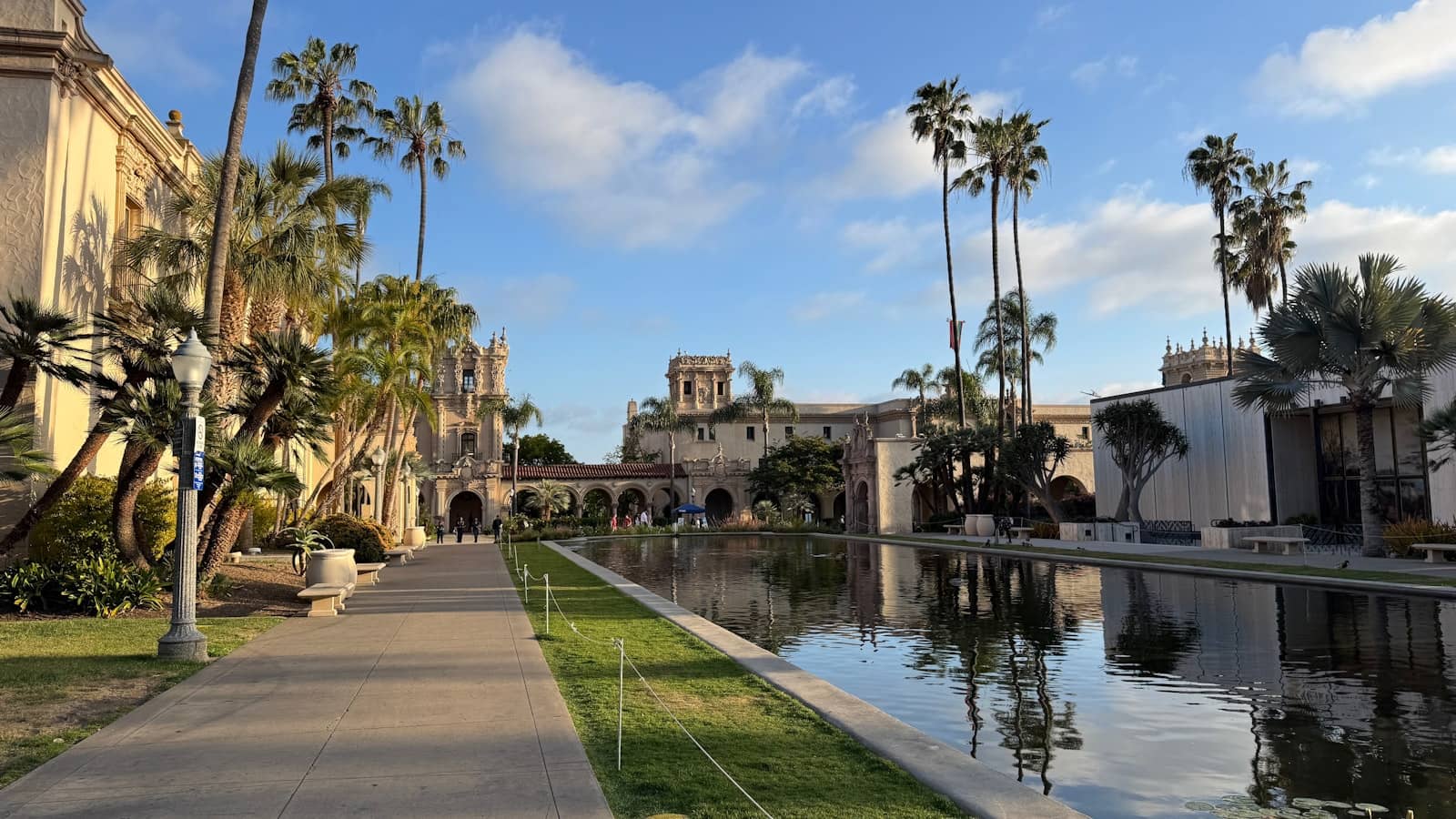
San Diego set aside the land for Balboa Park in 1868, and day three belongs to it. The Spanish-style buildings along El Prado went up for the 1915 and 1916 Panama-California Exposition, a world's fair that drew more than 3.7 million visitors. President Woodrow Wilson opened it by pressing a telegraph button in Washington.

Walk in over the Cabrillo Bridge, which was built for the exposition. Its architects, Bertram Goodhue and Frank P. Allen Jr., also designed many of the fair's buildings, and they skipped the usual Greek and Roman styles for Spanish and Mediterranean ones. Follow El Prado to the Botanical Building, a 1915 wood-lath structure by Carleton Winslow that sits beside its lily pond.

Then choose one museum or garden and check its admission rules, since each institution sets its own. One interior plus the free outdoor core makes a full, easy block and leaves energy for North Park. Several interiors turn the day into a string of closing times. The City normally runs a free ADA-accessible tram every 10 to 15 minutes through the day, though events and holidays can change that.

North Park food, books, and optional beer micro-loop

DAY 3 · ROUTE BLOCK
The move
Pick two nearby stops, like dinner and Verbatim Books, confirm their hours, and leave one slot open.

North Park began as a lemon grove. In 1893, James Monroe Hartley bought 40 acres here for citrus, and by 1911 and 1912 his son Jack and William Jay Stevens had turned it into a neighborhood, with the Stevens Building rising at 30th and University. Today it's the easygoing second half of day three.

The neighborhood's business directory sorts North Park into restaurants, bars and lounges, breweries and cideries, shops, and things to do. After a day in the park, there's no need to cover all of it. Pick two priorities within a short walk: dinner and a bookstore, or dinner and one drink.

For the books half, Verbatim Books on 30th Street is a secondhand and antiquarian shop with more than 50,000 books, plus zines and art prints, and it runs the North Park Book Fair. Independent shops tend to close earlier than restaurants and breweries, so browse first and eat second. If your trip includes a second Saturday, Ray Street hosts Ray at Night, a monthly gallery walk. Leave a third slot open for anyone who still has energy.

Little Italy and Embarcadero transition

DAY 3 · ROUTE BLOCK
The move
On a Wednesday or Saturday, shop the Mercato; otherwise book one Little Italy restaurant, then walk toward the bay.

Little Italy was a fishing neighborhood first. Italian and Portuguese families built it, and after the Pacific Tuna Canning Company opened in 1911, it became the hub of San Diego's tuna industry until the last canneries closed in the early 1980s. Today it's a compact restaurant district beside the waterfront, with India Street as its main street, and it closes day three as a meal and a walk toward the bay.

If your trip includes a Wednesday or Saturday, the Mercato is worth building around. The Little Italy Association calls it San Diego County's largest farmers' market, with more than 200 vendors. On Saturdays it fills six blocks of West Date Street, from west of Kettner Boulevard to Front Street, and the smaller Wednesday market covers three blocks. It runs year-round, rain or shine.

Any other day, choose one restaurant, book it, and walk toward the Embarcadero afterward. Amici Park is part of the neighborhood too. Pick the market or a sit-down meal, since doing both usually crowds the schedule.

Chicano Park mural core and Barrio Logan meal

DAY 4 · ROUTE BLOCK
The move
Start at the kiosko, spend an hour with the mural columns, then have lunch in Barrio Logan.

Chicano Park exists because a neighborhood stood its ground. On April 22, 1970, Barrio Logan residents found bulldozers preparing land under the new Coronado Bridge for a California Highway Patrol station. They formed human chains, planted trees and cactus, and held the site for 12 days until it was won for the park.

The murals came next, starting in 1973, painted on the concrete columns that hold up the bridge and freeway. The National Park Service counts 72 of them and says they tell the story of the Chicano movement. The park became a National Historic Landmark in 2016, and the Chicano Park Museum and Cultural Center opened in 2022.

Start at the kiosko in the center and work outward, giving the murals an unhurried hour. This is living community space, so keep photos considerate and give any gathering room. A meal in Barrio Logan fits naturally afterward, and there's no need to rush the park to get to it.

USS Midway focused visit

DAY 4 · ROUTE BLOCK
The move
Board early, cover the flight deck, the hangar and one docent route, and set your Coronado time first.

The USS Midway was commissioned in 1945 as the largest ship in the world, 1,001 feet long with a crew of about 4,500. She served until 1992, the only carrier in service through the entire Cold War, and roughly 200,000 sailors served aboard. In 2004 she opened as a museum at Navy Pier on the downtown waterfront, and she's the big maritime-history block of day four.

A ship that size needs a real window. Focus on the flight deck, the hangar and one docent-led route, and give the veteran docents your attention, since they're the part visitors bring up again and again. Below deck there are ladders and tight spaces, so read the museum's accessibility information before you commit.

The museum has listed hours of 10 a.m. to 5 p.m. daily, with last admission at 4 p.m. and closures on Thanksgiving and Christmas. Arrive well before the cutoff. Then settle how much of the afternoon Coronado gets, because a full Midway visit and a long island loop compete for the same hours.

Coronado ferry, village, and beach loop

DAY 4 · ROUTE BLOCK
The move
Pick your outbound and return sailings, rent a bike at Ferry Landing or plan the walk, and fit the village and beach between them.

Coronado is best reached across the water. The Flagship ferry makes the crossing in about 15 minutes, from Broadway Pier or from the Fifth Avenue Landing by the Convention Center, and the ride itself is part of the sightseeing.

Ferry Landing on the Coronado side has restaurants, shops and bike rentals. The village and the beach take more planning, since the Hotel del Coronado and Central Beach are a real trip from the dock. Decide on a bike or a planned walk before you board. The Del is worth the effort: it was built in 1888 and is a National Historic Landmark.

Plan the ferry first and the island second. Tickets are tied to the route you bought, and you can take any scheduled sailing on that route if there's room. Flagship asks riders to reach the dock at least 10 minutes early, with extra time on weekends and holidays, during conferences and after big events. If the Midway ran long, shorten the Coronado loop and keep your return sailing.

North County Coast rail or driving day

DAY 5 · OPTION A
The move
Choose train or car, pick one North County town, and plan the day around a confirmed return trip.

Day five is a choice, and this is the one for anyone who wants more coastline. The COASTER has run the Surf Line since February 27, 1995, a 41-mile corridor with eight stations between downtown San Diego and Oceanside, and the full ride takes about an hour.

It's frequent enough to plan around. North County Transit District runs 30 weekday trips, plus two more on Fridays, and 20 trips on Saturdays and Sundays, with fares priced by one, two or three zones. The stations make good anchors. Solana Beach's stop sits on Cedros Avenue, home of the Cedros Design District. Carlsbad Village station is a couple of blocks from the village. At the top of the line, the Oceanside Transit Center is a walk from the California Surf Museum, open since 1986.

Choose one town and one nearby stop, then build the day around a return train you've already confirmed. A car gives you more freedom to hop between beaches and towns, and the train is the relaxed option for anyone happy to skip the drive up the 5.

Convoy dinner district

DAY 5 · OPTION B
The move
Choose one restaurant for the table, confirm its hours, and add one dessert stop if there's room.

If day five should stay inland, end the trip on Convoy Street in Kearny Mesa, San Diego's great Asian food district. Its roots go back to 1979, when a Woo Chee Chong grocery and the first Zion Korean market opened here. Nijiya Market followed in 1986, and in 2020 the area was designated the Convoy Pan Asian Cultural & Business Innovation District after local businesses pushed for the name.

The range is the reason to come: Korean, Chinese, Vietnamese and Japanese cooking, ramen, dim sum and Cantonese, Korean fried chicken, desserts and brewhouses, spread along Convoy and the nearby Kearny Mesa grid. Some places go back decades. Phuong Trang opened on Convoy Street in 1992, and for many San Diegans it served their first bowl of phở.

Narrow it down before you cross town. Pick one cuisine and one restaurant, confirm its hours and address, and add dessert only if timing and appetite agree. Many restaurants share strip-mall plazas by suite number, and parking and waits can run long at dinner, so arriving a little early helps.

Where they are

Places · Linked to the guide
Boundary map · every pin links to its entry
Focus spotsHover, focus, or tap

How we built this itinerary

The order here follows the days, not a ranking. We looked at 20 possible stops and weighed each one on the experience (half the score), how specifically it belongs in a San Diego trip, access, fit for a five-day visit, safety and logistics, and local significance, then arranged the 14 keepers around opening times and drive times. A spot on this list can never be bought.

✓Route feasibility, official access, hard closing times, transit and ferry constraints, seasonal conditions, and safety guidance checked from July 24 through August 1, 2026

Common questions

What is the best 5-day itinerary for San Diego?

The best 5-day San Diego itinerary groups each day by area. Spend day one on the La Jolla coast and Mission Bay, day two in Old Town, Liberty Station and Point Loma, day three in Balboa Park, North Park and Little Italy, and day four in Barrio Logan, at the USS Midway and on Coronado. Use day five for one North County town or dinner on Convoy.

Is Torrey Pines State Natural Reserve open?

Torrey Pines State Natural Reserve closed to all visitors on September 22, 2026, for construction, and it's scheduled to reopen around March 1, 2027. The closure covers every trail, the Beach Trail staircase, the Lodge and the upper parking lots. Torrey Pines State Beach and its North Beach and South Beach lots stay open. Until the reserve reopens, start day one at La Jolla Cove.

Do you need a car for 5 days in San Diego?

La Jolla and Point Loma are the days where a car helps most, since the coast and the peninsula are spread out. Without one, stay Downtown or in Little Italy and lean on the harbor, the Coronado ferry, Balboa Park and a COASTER day up the coast. Allow extra transfer time either way.

Should the San Diego Zoo replace the Balboa Park day?

The San Diego Zoo deserves the whole day if it's one of your main reasons for visiting. Make it the anchor, drop the broader Balboa Park museum plan, and keep only a simple North Park dinner. Pairing the Zoo with several museums in one day leaves you rushing both.

Can you do the USS Midway and Coronado in one day?

The USS Midway and the Coronado ferry can share a day if one of them is the priority. The Midway has listed last admission at 4 p.m., and the ferry runs on a set schedule, so decide which gets the bigger window before the day starts and keep your return sailing.

Where should you stay for a 5-day San Diego trip?

Downtown or Little Italy is the most flexible base for this route, close to the harbor, the ferry and the city evenings. A coastal base shortens day one but adds drive time to the neighborhood days. Our where-to-stay guide compares the options by neighborhood.

Which days are easiest to swap for bad weather?

Balboa Park's museums, Old Town's historic buildings and Liberty Station's galleries are the easiest blocks to move into a gray or rainy window. Save the La Jolla coast, Mission Bay and Sunset Cliffs for clear weather, and keep nearby stops together when you swap.

What should you book or check ahead for a 5-day San Diego trip?

The USS Midway, your Coronado ferry sailings, your Balboa Park museum and the COASTER return train are the pieces to check ahead. Reserve only the meals and timed attractions your group can't do without, and recheck schedules the morning of each day, since hours and access can change.

Sources and verificationOfficial planning sources and dated primary evidence used to verify this guide.

About the author

The San Diego List blue asterisk editorial mark
By

Independent San Diego guide publisher

The publication byline for The San Diego List, published by Ezra Gonzalez. Independent guides use dated source research, clearly identified reporting and a public corrections process.

Keep planning

Read this next

A sunset picnic on the bluffs above the PacificUp next · ItinerariesThe Budget Weekend: San Diego for Under $150 a DayA Nico's breakfast burrito in Ocean Beach, a free organ concert in Balboa Park and Chula Vista tacos by trolley: two San Diego days for about $99.11 stops · Updated Jul 27 Keep reading →

More like this