Skip to content

This weekend: CRSSD Fall · Sat Doors noon both days · Tickets on sale

The San Diego List*
WEEKEND
Things to Do · Itineraries

The Perfect 4-Day San Diego Itinerary

A walk at La Jolla Cove, Old Town's five original adobes, Chicano Park's murals and a ferry to Coronado. Four San Diego days, one area at a time.

12 stopsCopy updated Sep 23, 2026Sources checked Aug 2, 2026By The San Diego List

The short answer

The best 4-day San Diego itinerary gives each day its own part of the city.

Day 1 walks La Jolla Cove and spends the afternoon in Pacific Beach or Mission Bay, adding an early Torrey Pines State Natural Reserve hike once its construction closure ends (planned for March 2027). Day 2 links Old Town, Liberty Station and Cabrillo National Monument in Point Loma. Day 3 pairs Balboa Park with North Park and Little Italy, and Day 4 covers Chicano Park in Barrio Logan, the USS Midway and the Coronado ferry.

NeighborhoodsLa Jolla →Torrey Pines →Mission Beach →Point Loma →Midway District & Liberty Station →Balboa ParkNorth Park →Little Italy →Barrio Logan →Downtown →Coronado →Old Town →

San Diego is a spread-out city. The north coast runs through Torrey Pines and La Jolla. Point Loma and the bays sit in the middle, Balboa Park and its neighborhoods fill the center of town, and the downtown harbor faces Coronado across the water. The trips that feel rushed here are usually the ones that try to touch all of it every single day.

This 4-day San Diego itinerary gives each of those places a day of its own. Day 1 is the north coast: a morning hike at Torrey Pines, a walk at La Jolla Cove and a beach afternoon in Pacific Beach or Mission Bay. Day 2 runs from the adobes of Old Town through lunch and art at Liberty Station to Cabrillo National Monument and a Sunset Cliffs finish. Day 3 is Balboa Park, an evening in North Park and a flexible stop in Little Italy. Day 4 belongs to the harbor, with the murals of Chicano Park, the USS Midway and the ferry to Coronado.

A few things make it work. A car saves real time on the coastal and peninsula days, and from a Downtown or Little Italy base, a car-free version can lean on the trolley, bus and ferry as long as you build in extra transfer time. Make one big choice each day, like one Balboa Park museum, one North Park meal, or the Midway versus a longer Coronado loop, and keep a little slack for weather or a slow morning. Then check the things that move: trail conditions, Cabrillo's closing time, the sunset for your dates, the Mercato calendar and the ferry schedule. And note the fall 2026 news: Torrey Pines State Natural Reserve is closed to all visitors for construction from September 22, 2026, with a planned reopening in March 2027, so until then Day 1 starts at La Jolla Cove.

For a shorter stay, the three-day itinerary trims the route, the five-day version adds a county extension, and our guides to San Diego without a car and where to stay will help you choose a base.

Before you go

What to check before each day

Hours, access and schedules shape this trip more than anything else, and all of them can change. Before you book anything, check Torrey Pines trail and parking conditions, the City's beach and water-use notices, Old Town's historic-site hours, Cabrillo's closing times, the sunset for your dates, admission at your chosen Balboa Park museum, the Mercato calendar, the Midway's hours and the live ferry schedule, including the last return. A change to any one of them can shorten or reorder a day, so a quick look that morning keeps the plan on track.

Torrey Pines reserve hike

DAY 1 · ROUTE BLOCK
The move
Once it reopens, pick one trail for your group or join a free 10 AM guided walk on a Friday, weekend or holiday. Until then, walk the state beach.

The first morning of the trip belongs to a trail. Torrey Pines State Natural Reserve, on North Torrey Pines Road in La Jolla, opens the four days because it gives you a coastal landscape unlike anything else on the route. It also sets the rhythm for everything that follows: one part of San Diego at a time, with enough room for each place to register before you move on.

For now, that trail has to wait. California State Parks closed the reserve to all visitors on September 22, 2026, for construction, and the closure covers every trail, the Beach Trail staircase, the Lodge and both upper parking lots. The reserve is scheduled to reopen in March 2027. Torrey Pines State Beach below it stays open, along with its North Beach and South Beach lots, so a trip before the reopening can start with a walk on the sand there or head straight to La Jolla Cove.

Once it reopens, timing shapes the whole visit. The reserve says its busiest window typically runs from 10 AM to 1 PM, and its parking lots can fill. That makes a strong case for an early start, when the trails are quieter and the rest of Day 1 still has plenty of room in it. The other good option is to lean into the busy hours on purpose. The reserve schedules free guided walks at 10 AM Friday through Sunday and on holidays, and a guide is a fine way to meet a place on your first morning in town. Check the current walk schedule before you plan around one.

Then pick one trail and let it be enough. Some routes in the reserve have steep grades, and heat and trail conditions can change what feels comfortable from one day to the next. Choose the route that suits the slowest walker in your group and that morning's trail conditions. A full circuit would spend the energy you'll want for La Jolla Cove and the beach later on, so save the rest of the reserve for a future trip, and carry plenty of water for the one you choose.

Flexibility is part of the plan. If the weather, the parking or a trail closure won't cooperate, shorten the walk and keep the day moving. Anyone who would prefer to skip the hike can start at La Jolla Cove instead, and the rest of the four days stays exactly as written. Either way, the group leaves the reserve with the day's hardest work behind it and the whole coast still ahead.

La Jolla public coast walk

DAY 1 · ROUTE BLOCK
The move
Walk the public Coast Boulevard path around La Jolla Cove for about an hour, watching wildlife from a respectful distance.

After the trail comes the shoreline. La Jolla Cove, on Coast Boulevard, is the second stop of Day 1, and the plan here is simple: one short public walk along the La Jolla coast, taken slowly, with the cliffs, the surf, the birds and the marine scenery providing the show.

The water in front of you is protected. The Cove sits inside the San Diego La Jolla Underwater Park Ecological Reserve, where fishing is prohibited and nothing natural leaves the beach with you. Treat the whole stretch as a place for watching. When wildlife is around, enjoy it from a respectful distance and follow the City's current wildlife notices, since wildlife closures, surf and access rules can all change which parts of the route are open.

It's a practical stop after a hike, too. The Cove has a permanent lifeguard station, restrooms and showers, which is just what a group coming straight off the Torrey Pines trail tends to need.

Keep the walk centered on the Cove and the Coast Boulevard path, and let the rest of the La Jolla shoreline wait for another visit. About an hour gives the coast real attention without turning Day 1 into a mileage contest. Getting here earlier in the day also eases the parking and the crowds, one more reason the hike starts early.

Pacific Beach and Mission Bay

DAY 1 · ROUTE BLOCK
The move
Choose one: sand and the Mission Beach boardwalk, or a single bay activity like a boat rental or bike ride. Add one food stop.

Day 1 finishes where plenty of San Diego daydreams begin: at the beach. Pacific Beach and Mission Bay connect the north coast to Point Loma with no inland detour, so this afternoon keeps the route on the water, and it makes an easygoing counterweight to a morning spent on the trail and the coast path.

The scale of Mission Bay Park is hard to take in. The City puts it at 4,235 acres of land and water, with 27 miles of shoreline, 19 miles of sandy beach, eight official swimming areas, boat rentals, playgrounds and nearly 14 miles of bike paths. That's a whole vacation's worth of waterfront in one park, and far too much for a single afternoon.

So choose one version and commit. The boardwalk-and-beach version centers on Pacific Beach and the Mission Beach boardwalk, with time on the sand and a walk along the boardwalk. The bay version trades that for a single activity: a boat rental, a ride on the bike paths or a stop at a playground if kids are along. Let the weather make the call between them.

Whichever you choose, park once and stay put. Parking and boardwalk crowds are the main things to plan around, and one activity plus a food stop is plenty after the morning you've had. Check the City's current beach, park, parking and water-use notices before you go, since access can change.

Your next good San Diego plan.
Places to try, weekend ideas and the local updates that change your plans. Join the early list. We’ll email you when the first issue launches.
By subscribing, you agree to receive The Shortlist by email when it launches. Free; unsubscribe anytime. See our privacy policy. Questions about The Shortlist?

Old Town State Historic Park

DAY 2 · ROUTE BLOCK
The move
Start with the historic core: the adobes, an open exhibit or a living-history demonstration. Shops and a meal come after.

Old Town State Historic Park opens Day 2 with the oldest chapter of the story. The park, on Wallace Street, traces San Diego from its time as Kumeyaay land through Mexican and then American settlement, and it tells that history with buildings you can walk right up to.

The park holds five original adobe buildings alongside restored structures, museum exhibits and a working blacksmith shop. Living-history demonstrations bring the past into the present tense, and one of them makes a great anchor for the morning. Music, shops and restaurants are part of the Old Town picture, too, so a meal or some browsing can follow once the history is done.

It helps to know which Old Town you came for. Commercial Old Town and the state historic park are two different things, and this morning is for the park. Start with its historic core, which you can explore without buying a tour, and choose a restaurant or a shop after that. Old Town's transit access also makes this an easy morning for anyone traveling without a car.

Historic-site access can change, so check California State Parks for current hours and closures before you go, and pick an open exhibit or demonstration as your anchor. Then set a firm departure time. Liberty Station and Point Loma are waiting, and Cabrillo's closing times won't bend for a long lunch.

Liberty Station arts and food loop

DAY 2 · ROUTE BLOCK
The move
One gallery or Arts District stop and one meal, with Liberty Public Market as a strong pick for the food half.

On the way from Old Town to Point Loma, Liberty Station handles the middle of Day 2: lunch, some art and a walk, all in one place where you park once and skip another trip across the city.

Liberty Station is big. It covers 360 acres, with restaurants, shops, art galleries, hotels, schools, live entertainment and outdoor venues, plus its own Arts District and Liberty Public Market. That mix of public space, art, history and food is why it earns the midday slot, and it fits naturally between the morning's history lesson and the afternoon on the peninsula.

It's also far too much for one itinerary block, so arrive with two decisions made. Pick one art stop, whether that's a single gallery or a wander through the Arts District, and one food destination. Liberty Public Market is the obvious candidate for the food half. Anything else you pass along the way is a bonus if the clock allows.

Galleries, market vendors and events all keep their own schedules, so confirm your two picks before you build the middle of the day around them. And keep one eye on the time. The afternoon has two fixed points, Cabrillo's closing time and the Sunset Cliffs finish, and Liberty Station is the part of the day that can stretch or shrink to protect them.

Cabrillo core with a reserved Sunset Cliffs finish

DAY 2 · ROUTE BLOCK
The move
Cabrillo first, inside its closing times, then a legal Sunset Cliffs viewpoint with time to settle in before sunset.

The Point Loma peninsula closes out Day 2 with a history stop and a clifftop finish. First comes Cabrillo National Monument, on Cabrillo Memorial Drive, which pairs history with a clear view of how the whole region fits together. Then comes Sunset Cliffs, saved for the end of the day.

Cabrillo gets the structured slot. The park and its internal areas keep firm daily closing times, so check them that morning and arrive with a real buffer. The drive out is an out-and-back on the peninsula, so Liberty Station comes first and Cabrillo follows while the gates are still open.

Sunset Cliffs Natural Park runs 68 acres along the Pacific, with carved coastal bluffs, arches and sea caves, panoramic ocean views and, in season, the chance of spotting gray whales. The best time to arrive depends on your travel date, so look up that evening's sunset and work backward from it.

The bluffs deserve respect. Use a legal blufftop viewpoint, stay well back from unstable edges and never cross a barrier for a better photo. If you're headed for the Ladera area, it has small parking lots and no restrooms, so plan for both before you get there.

Balboa Park architecture, gardens, and one museum

DAY 3 · ROUTE BLOCK
The move
Walk El Prado and the gardens, then spend unhurried time in the one museum you picked ahead.

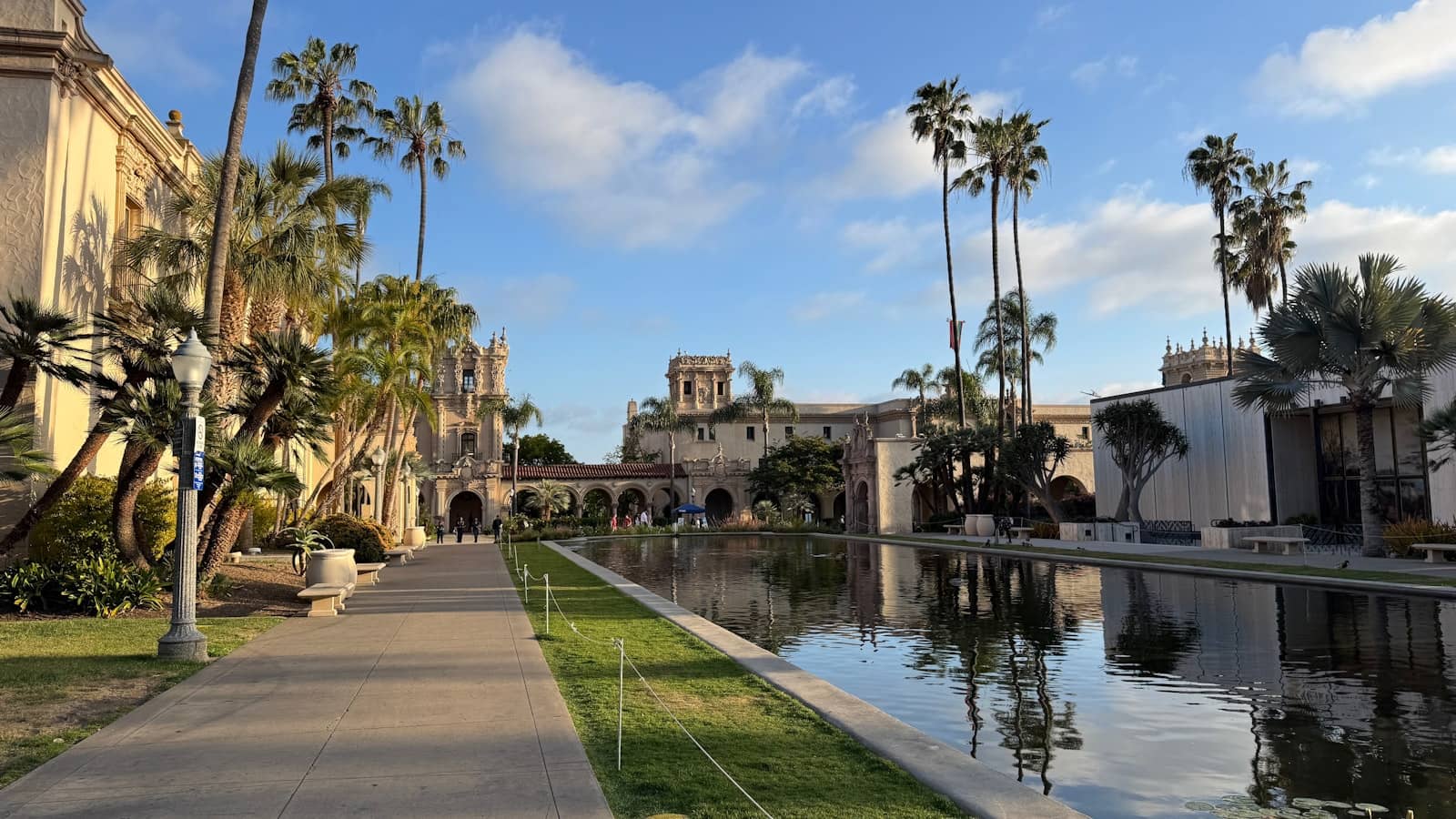
Balboa Park takes Day 3 inland, and the best way to meet it is on foot. Walk El Prado and the garden core first, with the architecture and the plantings as the main event, then give real time to a single museum.

The public core of the park is free to walk, and this day adapts well to any weather. Architecture and gardens carry a clear morning, and a museum carries a gray one, so the plan holds either way.

Choose your one museum or interior before you arrive and check its admission rules, since each institution in the park sets its own. One is plenty. Try to collect three or four and the park turns into a checklist, and there's less energy left for North Park in the evening.

When the distances start adding up, use the park's free, ADA-accessible tram. The City says it typically runs from 8 AM to 8 PM every 10 to 15 minutes, though special events, City holidays and scheduled activities can change or delay service, so check it for your date. And if the San Diego Zoo is on your list, make it the main event of this day and save the museum-and-garden loop for another trip. The two together make for a rushed day.

North Park food, books, and optional beer micro-loop

DAY 3 · ROUTE BLOCK
The move
One restaurant and one bookstore or shop, with a beer, cider or cocktail only if the evening has room.

North Park brings things down to street level after a day of Balboa Park's architecture and gardens. The evening stays compact around University Avenue and 30th Street, where the neighborhood's restaurants, bookstores, shops, cocktail bars, beer and cider give a group plenty of options without another long drive.

It's a neighborhood block, a change of pace from the formal attractions of the morning, and the mix of food, shopping and drinks works well for groups that want different things from an evening. The district's own directory sorts its businesses into restaurants, bars and lounges, breweries, distilleries and cideries, shopping, and things to do, and that list makes a handy menu for planning the night.

Make two decisions before you arrive: one meal, and one shop or activity. A bookstore makes a natural pick for the second. Add a drink only if the timing and the mood line up. Independent shops often close earlier than restaurants and breweries, so browse first and eat second.

Every business here sets its own hours, so confirm both of your picks for that day. Two decisions is the right amount of plan: enough to avoid a group-chat standoff, with room left to wander into something else along the way.

Little Italy and Embarcadero transition

DAY 3 · ROUTE BLOCK
The move
On a Wednesday or Saturday, the Mercato. On other days, one restaurant meal, then a walk toward the Embarcadero.

Little Italy is the hinge of this trip. The compact restaurant district sits beside the downtown waterfront, which makes it the natural bridge between the neighborhood days and the harbor, and it can play three roles: a market morning, a sit-down meal or a walk toward the water.

The calendar decides which one you get. The Little Italy Mercato is a farmers' market that the neighborhood holds on Wednesdays and Saturdays. If your trip lands on one of those days, make the market the anchor. On any other day, build the stop around a restaurant instead, then continue on foot from Little Italy toward the bay and the Embarcadero.

Pick one version. Squeezing a market visit and a sit-down meal into the same stop adds time without improving the route, and market crowds and dinner reservations each shift the timing in their own way. Keep any reservation separate from the market plan, and check the current Mercato details before you build around it.

Whichever version you choose, the walk toward the water sets up everything that follows. The harbor half of the trip starts here.

Chicano Park mural core and Barrio Logan meal

DAY 4 · ROUTE BLOCK
The move
Start at the kiosko, walk the mural columns for an unhurried hour, then have a meal in Barrio Logan.

The final day opens in Barrio Logan, beneath the freeway, at a park the National Park Service recognizes as a National Historic Landmark. Chicano Park holds 72 murals that, in the Park Service's words, tell the story of the Chicano movement, and they are the reason to come.

Start at the kiosko, then walk the mural columns slowly. Give the mural core an unhurried hour and treat the work as the purpose of the visit, with lunch as the follow-up. The compact core fits neatly before the harbor attractions later in the day.

Chicano Park is an active community space as well as a landmark, and that's part of what makes it matter. People gather here and events take place, so keep your photos considerate and give gatherings plenty of room. If something is underway when you arrive, adjust your path around it and come back to the murals you missed.

Afterward, stay in the neighborhood for a meal. A Barrio Logan lunch is the natural second half of this stop, and it gives the group a sit-down break before the Midway and the ferry.

USS Midway focused visit

DAY 4 · ROUTE BLOCK
The move
The flight deck, the hangar and one docent route, arriving well before the 4 PM last admission.

An aircraft carrier on the downtown waterfront is hard to overlook, and the USS Midway Museum repays the time you give it. This is the big interior of Day 4, a substantial dose of maritime history on North Harbor Drive, and it works best as a focused visit: the flight deck, the hangar and one docent route, then back outside to the waterfront.

Treat it as a commitment. A meaningful visit takes several hours, so the Midway replaces other harbor plans instead of joining them as a quick bonus. Decide before you arrive how much time you want left for Coronado.

The museum's published schedule runs from 10 AM to 5 PM daily, with last admission at 4 PM, and it closes on Thanksgiving and Christmas Day. Recheck before you go and arrive well ahead of that last admission. The museum also publishes accessibility information, which is worth reading before the day if anyone in your group needs it.

When the visit wraps up, the waterfront location makes a short Embarcadero walk easy. Then look at the clock and size the Coronado loop to what's left of the afternoon.

Coronado ferry, village, and beach loop

DAY 4 · ROUTE BLOCK
The move
Ferry to Coronado, then Ferry Landing, the village or Central Beach, with bus, bike or walking decided before you board.

The trip ends on the water. The ferry between downtown San Diego and Coronado is transportation and an experience at the same time, and the crossing makes a fitting final act for four days spent moving from the coast to the parks to the harbor.

On the Coronado side, Ferry Landing, the village and Central Beach can make one coherent half-day. Plan for the gaps, though. The Hotel del Coronado and Central Beach aren't right next to Ferry Landing, so decide before you board whether you'll take the bus, ride a bike or walk.

Size the island to the time you have. If the Midway took most of the day, keep Coronado compact. If the ferry outing is the main event, give it the bigger share of the afternoon and a shorter museum slot beforehand.

Flagship, the ferry operator, says tickets work on any scheduled departure for the route you bought, subject to capacity, and recommends arriving at least 10 minutes early. Confirm the landing, route, fare, outbound departure and return before you board, and leave margin on the return. The last crossing of the trip deserves to be a relaxed one.

Where they are

Places · Linked to the guide
Boundary map · every pin links to its entry
Focus spotsHover, focus, or tap

How we built this itinerary

Each stop was weighed mostly on what it adds to a full, memorable day, then on how specific it is to San Diego, how reliably you can pull it off, how well it fits a four-day trip, its safety and logistics, and its local significance. The order is the route itself, built around opening hours and travel between stops, and a spot on this list can never be bought.

✓Route feasibility, official access, hard closing times, transit and ferry constraints, seasonal conditions, and safety guidance checked July 24, 2026

Common questions

What is the best 4-day San Diego itinerary?

Torrey Pines, La Jolla Cove and Pacific Beach make the strongest first day, and the rest of a 4-day San Diego itinerary works best when each day covers one part of the city. Spend Day 2 on Old Town, Liberty Station and Point Loma, Day 3 on Balboa Park, North Park and Little Italy, and Day 4 on Chicano Park, the USS Midway and the Coronado ferry. That covers the coast, the parks, the neighborhoods and the harbor without crossing the county between stops. Until the Torrey Pines reserve reopens from construction, planned for March 2027, start Day 1 at La Jolla Cove.

Do you need a car for 4 days in San Diego?

Torrey Pines, La Jolla and Point Loma are much easier with a car, because the coast and the peninsula are spread out. A car-free version still works from a Downtown or Little Italy base. Lean on the trolley, bus and ferry, favor the harbor, Balboa Park, the nearby neighborhoods and Coronado, and build extra transfer time into the harder coastal connections.

How does the San Diego Zoo fit into a 4-day itinerary?

The San Diego Zoo works best as the main event of the Balboa Park day. It's a big visit on its own, so choose the Zoo or the broader museum-and-garden version of the park, not both, and pair it with a simple North Park evening. Check the Zoo's hours, admission, parking and accessibility for your date before you go.

Can you do the USS Midway and Coronado on the same day?

The USS Midway and Coronado fit on the same day as long as one of them is the priority. The Midway's published hours are 10 AM to 5 PM with last admission at 4 PM, and a meaningful visit takes several hours. After a full Midway visit, keep Coronado compact; if the island is the main event, give the Midway a shorter slot. Confirm the ferry's return schedule before you board.

What should you do on an arrival afternoon in San Diego?

Old Town State Historic Park can work on an arrival afternoon when its current hours line up. It has transit access and a historic core you can explore without buying a tour. Otherwise, settle into your base and start the route the next morning, and save Torrey Pines and La Jolla for a day when you can get an early start.

Can you skip the Torrey Pines hike?

La Jolla Cove makes an easy starting point for anyone who wants to skip the Torrey Pines hike, and it's the plan for everyone until the reserve reopens: Torrey Pines State Natural Reserve is closed to all visitors for construction from September 22, 2026, with a planned reopening in March 2027. Start Day 1 with the coast walk or a walk on Torrey Pines State Beach, which stays open, and the rest of the four-day route stays the same.

Where should you stay for 4 days in San Diego?

Downtown or Little Italy is the easiest base for these four days. Either one keeps the harbor day close and makes a comfortable home after the longer drives. A coastal base shortens the Torrey Pines and La Jolla day but lengthens the city days. Our where-to-stay guide compares the tradeoffs.

Sources and verificationOfficial planning sources and dated primary evidence used to verify this guide.

About the author

The San Diego List blue asterisk editorial mark
By

Independent San Diego guide publisher

The publication byline for The San Diego List, published by Ezra Gonzalez. Independent guides use dated source research, clearly identified reporting and a public corrections process.

Keep planning

Read this next

A sunset picnic on the bluffs above the PacificUp next · ItinerariesThe Budget Weekend: San Diego for Under $150 a DayA Nico's breakfast burrito in Ocean Beach, a free organ concert in Balboa Park and Chula Vista tacos by trolley: two San Diego days for about $99.11 stops · Updated Jul 27 Keep reading →

More like this