Skip to content

This weekend: CRSSD Fall · Sat Doors noon both days · Tickets on sale

The San Diego List*
WEEKEND
Things to Do · Things to Do

The 20 Best Things to Do in San Diego

Balboa Park's 1915 world's fair buildings, sea lions at La Jolla Cove and a 1925 wooden coaster in Mission Beach. San Diego's 20 best and how to plan each.

20 rankedCopy updated Sep 23, 2026Sources checked Jul 27, 2026By The San Diego List

The short answer

The best thing to do in San Diego is Balboa Park.

It grew out of the 1915 Panama-California Exposition, and walking El Prado, Palm Canyon and the Botanical Building costs nothing, with a museum to add when you're ready. Next, give the San Diego Zoo its own day in the same park, walk the La Jolla coast from the Cove to the Children's Pool for sea lions and harbor seals, or read the murals at Chicano Park in Barrio Logan.

NeighborhoodsBalboa ParkLa Jolla →Barrio Logan →Point Loma →Downtown →Coronado →Escondido →Old Town →Mission Beach →Midway District & Liberty Station →Convoy District →Little Italy →

San Diego spreads its best stuff across the whole county. A world's fair in 1915 gave the city Balboa Park as we know it. A 1970 neighborhood standoff over a patch of land under a freeway produced Chicano Park and its murals. An aircraft carrier from 1945 now sits on the Downtown waterfront, a wooden roller coaster from 1925 still gives rides in Mission Beach, and every Saturday a farmers market takes over six blocks of Little Italy. Add sea lions in La Jolla and whale-watching trips out of Mission Bay in every season, and you start to see why one day is never enough.

This list ranks the 20 best things to do in San Diego for a first trip, and there's plenty in here for locals planning a weekend too. It runs from Balboa Park and the bay out to La Jolla, Barrio Logan, Point Loma, Coronado, Mission Beach and the Safari Park in Escondido. We looked at 72 possibilities around the county, took a closer look at 50 and ranked these 20 on the quality of the experience first, then how only-in-San-Diego each one is, how easy it is to plan and fit into a route, value, and current safety and logistics. A spot on this list can never be bought.

A few things make the trip easier. Plan in clusters: the Midway pairs with the Embarcadero, the ferry pairs with Coronado, and Chicano Park flows straight into Logan Avenue. La Jolla deserves its own half day, so keep it out of a day that already has Cabrillo and the Safari Park, which sit far apart. Book the Zoo, the Safari Park, the Midway, a Rady Shell show, the sea-cave kayak tour, a whale-watching trip and any surf lesson ahead, and buy Padres games and ballpark tours by exact date. Plenty of these are free to walk into, but parking, food, rides and tours still need a budget. One timely note: Torrey Pines State Natural Reserve (#14) is closed for construction, with a planned March 2027 reopening.

Our 3-day San Diego itinerary puts these stops in travel order, where to stay by vibe helps you pick a base, and San Diego without a car sorts out which ones work on transit.

01Our pick

Balboa Park

BALBOA PARK · FREE GROUNDS · MUSEUMS EXTRA · GIVE IT HALF A DAY★ 4.8 Google (78,894)
The move
Walk El Prado, then Palm Canyon and the Botanical Building, all free, and add just one museum.

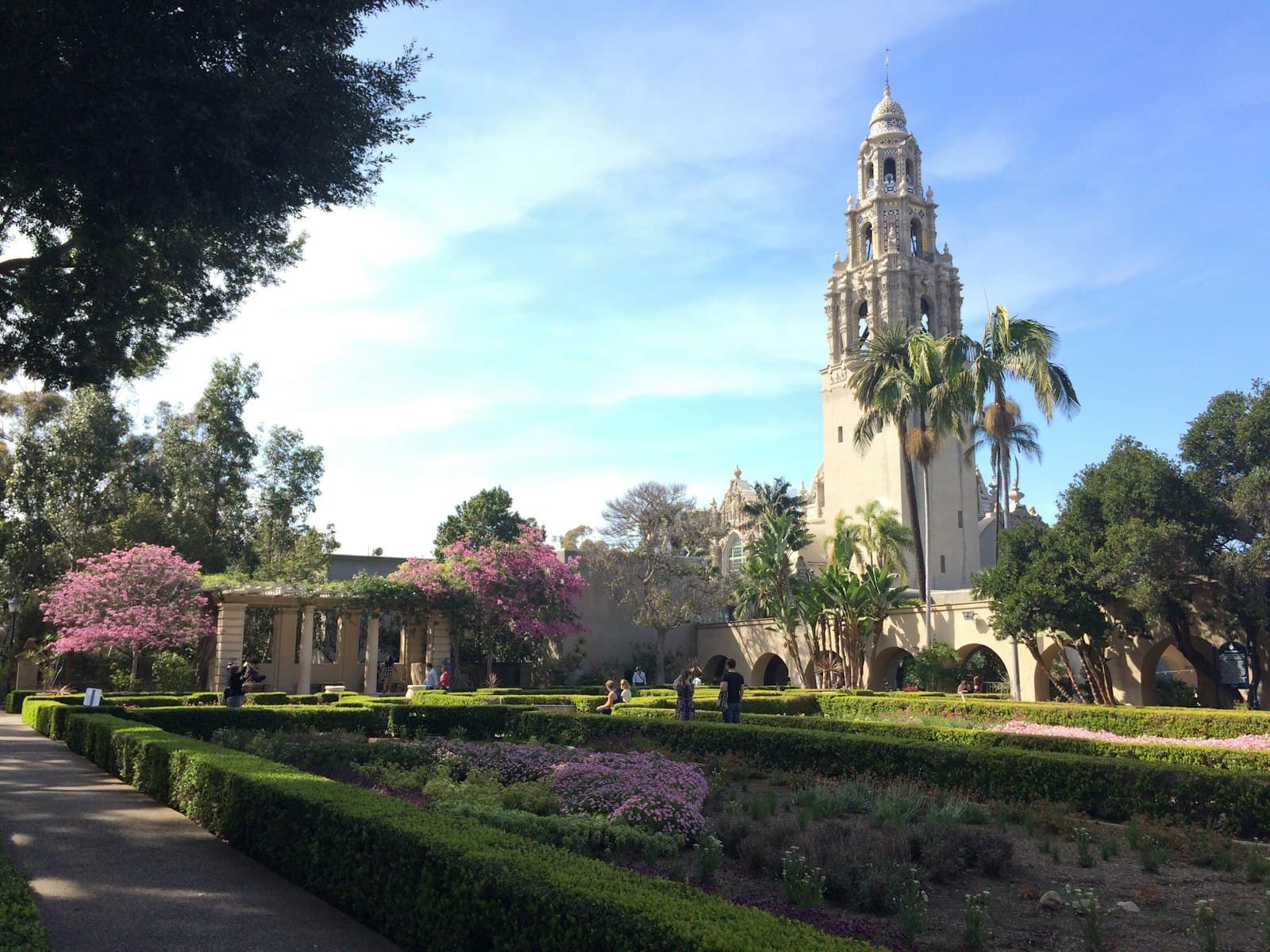
Balboa Park owes its look to a world's fair. The park grew out of the 1915 Panama-California Exposition, and the architecture and grounds you walk through today date to that fair. More than a century later, it's still the best first day in San Diego: gardens, museums, trails and exposition-era buildings in one big park, with a generous share of it free.

Start on foot. Walk El Prado first, then head to Palm Canyon and the Botanical Building. All three are free, and together they give you the architecture, the gardens and a feel for how the park fits together before you've spent a dollar. The Timken Museum has free admission too, so an art stop fits right into the walk without a ticket.

Then pick one museum. Just one. The range of museums is a big part of why people love this park, and it's also how a great day turns into a tired one. The park is large enough that the usual regret is trying to do too much in one visit. Choose the museum that fits your group, give it real time, and save the rest for your next trip. Hours vary from museum to museum, so check the one you want before you build the day around it.

The praise for Balboa Park is wide. People single out the gardens, the architecture, the range of museums, how walkable it is and how many hours you can fill without paying for anything. That mix is why it sits at #1. No other stop on this list hands a first-time visitor this much of San Diego's culture, history and green space in one place.

Two planning notes. The San Diego Zoo sits inside the park's grounds, but it's a full day of its own (it's #2 on this list for good reason), so don't try to squeeze it into a museum day. And parking changed in 2026. Nonresidents now pay $10 to $16 a day depending on the zone, with the first 3 hours free in Level 3. Check the city's current rates before you count on any old free-parking advice.


02

San Diego Zoo

BALBOA PARK · $78 ADULT ANY-DAY · FULL DAY · ARRIVE AT OPENING★ 4.7 Google (66,810)
The move
Ride the included double-decker bus tour first, use the Skyfari to cross the park, then pick two zones.

The San Diego Zoo lives inside Balboa Park, but it asks for a whole day of its own. This is a globally recognized collection of animal habitats spread across hills that are steeper and bigger than the map lets on, and it's run by San Diego Zoo Wildlife Alliance, a nonprofit. If Balboa Park is the city's best all-around day, the Zoo is its best single ticket.

The smartest move is already included in that ticket. Ride the double-decker bus tour first thing. It takes you through the hills and shows you how the whole place is laid out, which saves your legs for the parts you actually want to linger in. Later, use the Skyfari aerial tram to cross the park overhead and skip the long walk back.

After that, choose two zones and give them real time. The Zoo is too big to cover end to end in one visit, and trying is how people end up marching past habitats instead of watching them. Two areas done slowly will stick with you longer than ten done at a jog.

Hours follow a seasonal calendar and change by date, so look up the day you're going and be at the gate when it opens. Wear real walking shoes and bring water. You'll cover a lot of ground even with the bus and the Skyfari doing some of the work.

One more thing to know if you're planning a longer trip. The related Safari Park (#10) is a separate full day out in Escondido, with open-range habitats and a new elephant habitat that opened in 2026. It's a different trip, so plan it as its own day.

03

Walk from La Jolla Cove to the Children's Pool

LA JOLLA · FREE · SEA LIONS & SEALS · PUBLIC WALKWAY ONLY★ 4.8 Google (10,539)
The move
Start at the Cove for the sea lions, then walk south on the Coast Boulevard path to the Children's Pool seals.

Hundreds of California sea lions haul out on the rocks at La Jolla Cove, and seeing them costs you nothing but a walk. This free stretch of the La Jolla coast starts at the Cove, with sea lions on the rocks below, then follows the public Coast Boulevard path south to the Children's Pool, where the harbor seals gather. Two kinds of marine mammals, one walk, no tickets.

The crowd on the rocks has grown over the years. Sea lion numbers at the cove climbed after the federal Marine Mammal Protection Act passed in 1972, and today there are hundreds of them. On warm days, all those sea lions and seabirds make their presence known by smell too. Consider it part of the front-row experience.

The cove is part of the San Diego–La Jolla Underwater Park, an ecological reserve, and the rules are strict. Surfboards, kayaking, fishing and collecting shells or tide-pool creatures are all prohibited there. The water still gets its moment: every September the cove hosts the annual La Jolla Cove Rough Water Swim, and it's also home to the La Jolla Concours d'Elegance car show.

Plan the walk around a few practical things. Point La Jolla and Boomer Beach are closed year-round through 2030, so stay on the public walkway and behind the barriers. Steep concrete steps lead down to the cove beach if you want to get closer to the water. On-street parking around here is extremely limited, and mornings are usually the easiest time to find a spot and a clear stretch of path.

It ranks #3 because few things in San Diego pay off this much for this little effort: wildlife and coastline in a single free outing, with the rest of La Jolla right there when you're done.

Your next good San Diego plan.
Places to try, weekend ideas and the local updates that change your plans. Join the early list. We’ll email you when the first issue launches.
By subscribing, you agree to receive The Shortlist by email when it launches. Free; unsubscribe anytime. See our privacy policy. Questions about The Shortlist?
04

Chicano Park and Logan Avenue

BARRIO LOGAN · FREE · NATIONAL HISTORIC LANDMARK · READ THE MURALS★ 4.6 Google (4,810)
The move
Walk one mural cluster at a time and read them, then continue down Logan Avenue.

On April 22, 1970, a Barrio Logan resident named Mario Solis found bulldozers on land the neighborhood had long been promised as a park. The plan was a parking lot for a California Highway Patrol substation. Neighbors and students formed human chains around the bulldozers and planted trees and cactus right on the spot, and the 12-day occupation that followed won the land. That's how Chicano Park began.

What grew there is the largest collection of outdoor murals in the United States. A 1978 Mural Marathon, held April 1 to 22 that year, added roughly 10,000 square feet of murals on its own, and a 2012 restoration project touched up 23 of them. The park joined the National Register of Historic Places in 2013, and in December 2016, then-Interior Secretary Sally Jewell named it a National Historic Landmark.

Give it time. Walk one cluster of murals at a time and read them, the way you'd read the walls of a museum. A quick photo of one big panel misses most of what's here. Then keep going onto Logan Avenue and spend a while with the neighborhood's businesses, so the visit supports the community that fought for this ground.

It's #4 because nothing else here is this specific to San Diego: a free, landmark-level art collection that exists because neighbors stood their ground in 1970. Parking nearby is limited and the freeway overhead is loud, so give yourself a few extra minutes to find a spot. And remember that this is an active community park. If there's a gathering or event going on, give it room and enjoy it from the edges.

05

Cabrillo National Monument

POINT LOMA · $20 PER CAR · PASS GOOD 7 DAYS · LIGHTHOUSE & TIDE POOLS★ 4.8 Google (12,752)★ 4.6 Yelp (827)
The move
Overlook first, then the Old Point Loma Lighthouse, then ask a ranger which trail fits the day.

In 1542, Juan Rodriguez Cabrillo came ashore on Point Loma, the first European to make landfall on what's now the West Coast of the United States. Cabrillo National Monument marks that landing, and it pairs the history with a view that takes in more of San Diego at once than almost anywhere else.

Start at the overlook. From one spot you can see the bay, the Downtown skyline, Coronado, the open Pacific and Mexico. Then walk over to the Old Point Loma Lighthouse, a historic structure on the grounds; in spring, watch for wildflowers along the approach. After that, ask a ranger which trails suit the day. The Bayside Trail and the Coastal Trail are the two named routes.

The tide pools take a little homework. You want a tide around 0.7 feet or lower, and in summer the good low tides often land outside gate hours. Look at the park's annual tide table before you make the tide pools the reason for the trip, and plan the rest of the visit around the one window that works.

Here's the helpful part: the $20 vehicle pass is good for 7 days. If the tide doesn't line up on your first visit, come back later in the week without paying twice. Overlook and lighthouse one day, tide pools another.

It ranks #5 for that combination of national-park history, one panoramic view you won't get anywhere else and real tide-pool access. It's also a natural half day to pair with the rest of Point Loma, including Sunset Cliffs (#8) and Liberty Station (#15).

06

USS Midway Museum and the Embarcadero

DOWNTOWN · $39 ADULT ONLINE · 4+ HOURS · WATERFRONT WALK★ 4.8 Google (53,312)★ 4.7 Yelp (2,098)
The move
Flight deck at opening, then below decks, then a walk up the Embarcadero toward Waterfront Park.

When the USS Midway was commissioned in 1945, it was the largest ship in the world. It ran 1,001 feet long, carried a crew of about 4,500 and put out 212,000 horsepower, and at sea its laundry ran to about 43,000 pounds a week. Today it's a museum on the Downtown waterfront, and one of the rare places anywhere you can walk an intact aircraft carrier.

Head to the flight deck as soon as it opens, before the ship gets busy and the exposed deck heats up. Restored aircraft fill the top level, and the included audio tour and veteran docents supply the stories behind them. Then go below decks, through narrow passages and up and down ladders into the crew spaces.

Give it at least 4 hours to do both levels properly, and buy tickets online, since pier parking and the entry line build through late morning. When you're done, walk the Embarcadero past the historic ships on the pier toward Waterfront Park. Next door, McGrath Freedom Park, a new veterans park at Burnham Navy Pier, is planned to open in 2028.

07

Ride the Coronado Ferry and Walk to the Del

CORONADO · $9 EACH WAY · 15 MINUTES · CAR-LIGHT HALF DAY
The move
Take the Flagship ferry from Broadway Pier or the Convention Center, then walk to the Del and the beach.

The fastest way to make Coronado feel like a getaway is to arrive by boat. The Flagship ferry crosses from Downtown in about 15 minutes, with one-way tickets starting at $9, and it turns a trip to the Hotel del Coronado into a car-light half day with a boat ride at each end.

Two routes run from Downtown. The Broadway Pier boat leaves about every 60 minutes, and the Convention Center boat about every 30. Frequency differs by route, so check the timetable for yours in both directions before you leave. Be at the dock at least 10 minutes before departure, and earlier at busy times.

From the Coronado landing, head toward Orange Avenue, the Hotel del Coronado and the public beach beyond it. Budget more time for that walk than the map suggests, since the inland stretch is longer on foot than it looks. The Del and its beach are the payoff, and the boat back to Downtown closes out the day.

If anyone in your group plans to swim off Coronado, check the county's same-day water advisory first.

08

Sunset Cliffs Natural Park

POINT LOMA · FREE · LEGAL BLUFFTOP · ARRIVE BEFORE SUNSET★ 4.8 Google (8,866)
The move
Park near Ladera Street, walk south, and settle in well back from the edge an hour before sunset.

Sunset Cliffs Natural Park is 68 acres of carved bluffs, natural arches and sea caves along the Point Loma coast, and it's free. The name tells you when to come, and during the migration season you can spot gray whales from the bluffs, too.

The Kumeyaay originally used this stretch of coast to gather seafood and plants. During the 1915 Panama-California Exposition, developer Albert Spalding spent roughly $2 million here on bridges, trails, benches and a stairway into the ocean, and in 1925 John D. Mills bought the area and developed it further. The park was formally dedicated in 1983. If it looks familiar, it's been in Almost Famous and Veronica Mars.

Park near Ladera Street and walk south until you find a spot well back from the edge. Surfers ride the breaks below, and tide pools appear at low tide. Take the cliffs seriously: the edges are unfenced, they erode, and falls here have killed and injured people. Arrive about an hour before sunset so you can read the ground in daylight, and head out while you can still see your footing.

09

See Petco Park at a Game or on a Tour

EAST VILLAGE · GAME OR YEAR-ROUND TOUR · DATE-SPECIFIC · BOOK DIRECT★ 4.7 Google (23,053)★ 4.2 Yelp (2,162)
The move
Catch a game and find Gallagher Square, or book the roughly 80-minute stadium tour on an open date.

Petco Park, the Padres' ballpark in East Village, was built around a piece of old San Diego. The historic Western Metal Supply Co. building is worked right into the left-field stands, so one corner of a modern ballpark is a piece of the city's history.

You've got two ways in. A game is the classic, and you don't even need an assigned seat to get a view: during games, Gallagher Square offers first-come viewing space. The other option is the stadium tour, which runs roughly 80 minutes and suits anyone visiting on a day without a game or anyone who wants the ballpark at a slower pace.

Tours have blackout dates around games, concerts and other events, so buy your exact date directly from the Padres and check what's actually on sale before you plan around it. While you're there, find the ballpark's other named public spaces, Palm Court Plaza and Tony Gwynn Plaza.

It makes the list for the architecture and the skyline views, and because either way you do it, game or tour, it's easy to book ahead.

10

Safari Park and Elephant Valley

ESCONDIDO · FULL DAY · ELEPHANT VALLEY · HOTTER THAN THE COAST★ 4.7 Google (29,005)
The move
Africa Tram first, then Elephant Valley and one more area of your choice.

The Safari Park opened on May 10, 1972, a little over a month after its original April 1 date. Today it spreads across about 1,800 acres in Escondido, with more than 300 of them given over to open-range habitats, and it holds roughly 3,500 animals from more than 400 species. About 1.6 million people visit a year.

The big news is Elephant Valley. The Denny Sanford Elephant Valley opened in March 2026: a 13-acre habitat with mud baths and watering holes, plus Mkutano Park, a two-story restaurant. San Diego Zoo Wildlife Alliance calls it the largest single project in its 100-plus-year history. Make it the centerpiece of your day.

Ride the Africa Tram first, before the line builds. The tram replaced the park's earlier monorail in March 2007, runs on biofuel and travels counterclockwise through the African field exhibits. Then pick two areas, Elephant Valley and one more, and give them real time.

Treat this as its own full day. Escondido runs much hotter than the coast, the walking distances are long, and hours shift with the season, so check the calendar, carry water and leave the coast early.

11

Hear a Concert at the Rady Shell

EMBARCADERO · OUTDOOR CONCERT · SKYLINE & BAY · PICK A REAL SHOW★ 4.8 Google (3,097)★ 3.8 Yelp (286)
The move
Pick a named show from the season calendar, then choose between the lawn and fixed seats.

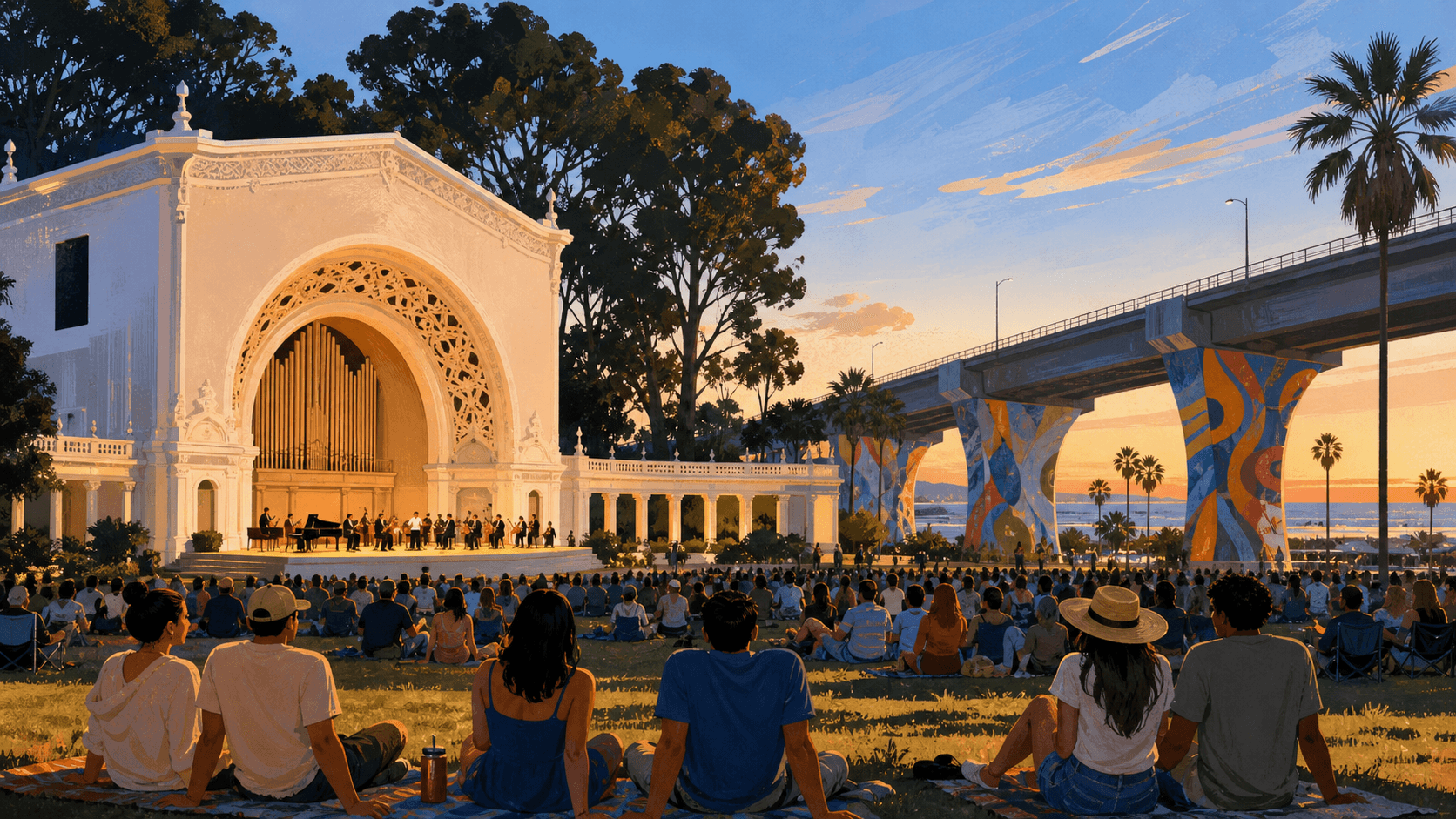
Picture a full symphony orchestra playing at the edge of San Diego Bay. The Rady Shell at Jacobs Park opened on August 5, 2021, at Embarcadero Marina Park South as the permanent outdoor home of the San Diego Symphony, and the grounds can hold up to 10,000 people.

London-based Soundforms designed the shell itself, with Tucker Sadler Architects on the overall project. The final cost came to about $85 million, more than 99% of it privately funded, and the two names on the venue belong to its lead donors: Ernest and Evelyn Rady, who gave $15 million, and Irwin Jacobs, who gave $11 million.

There's no show every night, so start with the season calendar and pick a named performance. Then compare the lawn with the fixed seats, since each comes with its own sightlines and ticket setup. Gates usually open about 90 minutes before showtime, which leaves time to settle in before the music starts.

Bag rules, parking and lawn access are set by each event, so read the details for yours. And whatever the afternoon felt like, bring a layer for the bay wind after dark.

12

Old Town San Diego State Historic Park

OLD TOWN · FREE · 1820s–1870s HISTORY · TROLLEY ACCESS★ 4.7 Google (31,620)★ 4.1 Yelp (583)
The move
Join a walking tour at 10:30am, noon or 2pm, and stop by the blacksmith shop.

Old Town San Diego State Historic Park tells the city's story from 1769 onward: Kumeyaay village life, the Spanish colonial years, the Mexican era and the American frontier settlement that followed the Mexican-American War. It's free, it's run by the state, and it has the real thing: five original adobe buildings from that period, including Casa de Estudillo, alongside reconstructed and early-20th-century structures.

Start with the living history. A working blacksmith shop demonstrates the trade, and scheduled walking tours head out at 10:30am, noon and 2pm, with music and period-dress family programs around them. The First San Diego Courthouse now runs as a museum, and an outdoor exhibit, Iipay ~ Tipai Kumeyaay Mut Niihepok, or Land of the First People, tells the Kumeyaay history of the site.

Individual museum buildings and demonstrations rotate, so some doors may be closed even while the park is open. Let whatever's running that day shape your route.

The shops and restaurants around the park are their own outing, separate from the history the state park interprets. Enjoy both, and know which one you're in.

13

Ride the Boardwalk and Giant Dipper at Belmont Park

MISSION BEACH · FREE TO ENTER · PAY PER RIDE · HISTORIC COASTER★ 4.6 Google (17,924)★ 3.9 Yelp (940)
The move
Ride the Giant Dipper on individual tickets, then walk or bike the Mission Beach boardwalk.

The Giant Dipper opened in Mission Beach on July 4, 1925, and it's one of only two wooden roller coasters in the country with National Historic Landmark status. That's 2,800 feet of track topping out around 48 mph, and it's the reason to come to Belmont Park.

It nearly didn't survive. John D. and Adolph Spreckels built the park, first called the Mission Beach Amusement Center, as a roughly $2.5 million real-estate development to draw visitors to Mission Beach. The family later left it to the city, which leased it to Jack Ray in 1954, and he renamed it Belmont Park. In 1955 a fire badly damaged the coaster and led to bankruptcy proceedings. A citizen campaign saved it from demolition in 1978, the same year it joined the National Register of Historic Places. It became a National Historic Landmark in 1987 and was fully restored in 1989 and 1990.

Belmont Park is free to enter, so you can ride just the Dipper without buying a full day. Rides use individual tickets or a wristband, and the arcade is priced separately. Afterward, walk or bike the Mission Beach boardwalk. Ride availability and prices change by date and maintenance, and the boardwalk gets congested on summer afternoons, so slow down and share the path.

14

Torrey Pines State Natural Reserve

TORREY PINES · CLOSED UNTIL MARCH 2027 · COASTAL RESERVE · STATE BEACH OPEN★ 4.8 Google (15,584)
The move
Until the planned March 2027 reopening, visit Torrey Pines State Beach and save the Guy Fleming loop for spring.

First, the timing. Torrey Pines State Natural Reserve is closed to all visitors from September 22, 2026, through a planned reopening in March 2027. California State Parks closed the park road to cars on September 21 and the entire reserve the next day for its Phase II construction. Save this one for spring.

It stays on the list because of what's waiting when it reopens. Torrey pines are one of the rarest pine species in North America, and this reserve and Santa Rosa Island are the only two places they grow natively. The Guy Fleming loop is a short route through those pines and eroded sandstone, with bluff, canyon and ocean views, and the Beach Trail can carry the outing down to the sand when access and the tide allow.

The work covers new gas, water, wastewater and communication lines, plus accessibility upgrades, and it's timed around the California gnatcatcher's nesting season. There are no refunds for the closure.

In the meantime, the coast below is still open. Torrey Pines State Beach stays open during the work, along with the South Beach and North Beach parking lots.

15

Build a Liberty Station Arts and Food Loop

POINT LOMA · ARTS DISTRICT · PUBLIC MARKET · FIRST FRIDAY
The move
Arts District studios first, then across the lawns to Liberty Public Market for lunch.

Liberty Station was once the Naval Training Center, and the 360-acre campus in Point Loma now makes one of the easiest afternoons in the city: art, lunch and open lawns, all on foot from one parking spot.

Start in the Arts District, where studios and galleries fill the old Naval Training Center buildings. Then cross the lawns toward the water and stop at Liberty Public Market for lunch, where everyone in your group can pick something different.

Timing matters here. Studio and gallery hours vary by day, and a quiet weekday can feel sparse if you're expecting every door to be open. First Friday is the answer, with open studios and evening programming. In 2026, the district is also running programming tied to the country's 250th anniversary.

It ranks here because it's a real historic military campus put to new use, walkable from end to end, with the art and the food in the same loop. It also pairs nicely with Cabrillo (#5) and Sunset Cliffs (#8) for a Point Loma day.

16

Kayak the La Jolla Sea Caves

LA JOLLA · $89 SINGLE · $109 TANDEM · CAVE ENTRY NOT GUARANTEED★ 4.7 Google (2,671)★ 4.6 Yelp (3,561)
The move
Book the earliest tour of the day, and go tandem if either paddler is new.

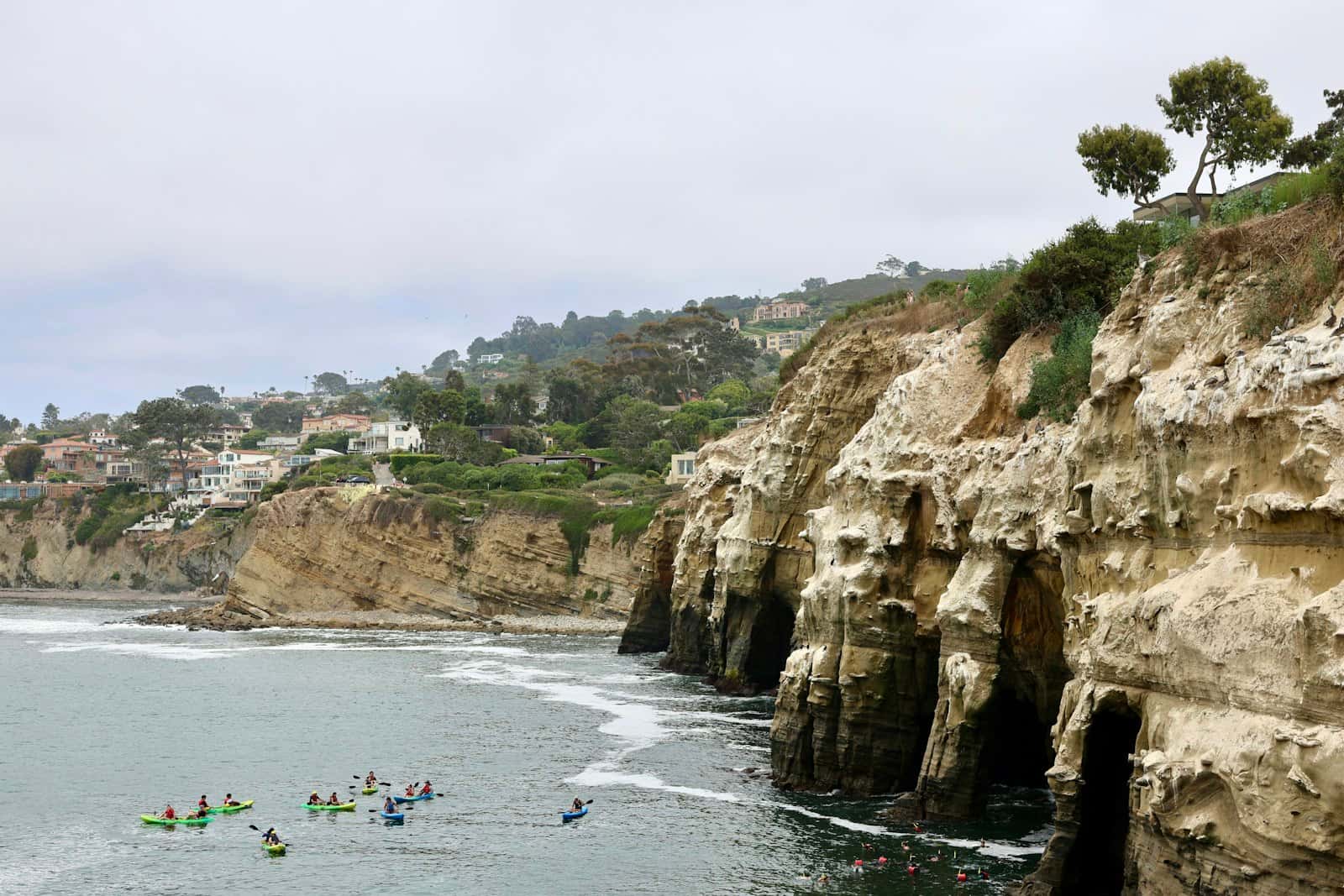
You don't need to know how to kayak to paddle La Jolla's sea caves. Everyday California's guided tour launches from its shop at 2261 Avenida de la Playa, hands you a life jacket, a paddle and an optional wetsuit, and heads out through the marine reserve toward what it calls the Seven Sea Caves.

Along the way you may pass the well-known Sunny Jim Cave and spot sea lions, leopard sharks and orange Garibaldi fish. If conditions allow, the group may even paddle into Emerald Cave. Cave entry is never guaranteed, though. Surf, wind and the guide's judgment decide it that morning.

Tours run about 90 minutes, year-round, with several start times a day and groups capped at 20. Singles start at $89 and tandems at $109. Kids as young as 5 can ride in a tandem with an adult, and solo kayaks start at age 15. Weight limits are 300 pounds for a single and 425 for a tandem.

Book the earliest tour of the day, and go tandem if either of you is new. That way the experienced paddler can steer while the other one watches for Garibaldi.

17

Eat Your Way Through the Convoy District

CONVOY · PAN-ASIAN DISTRICT · PARK ONCE · CHOOSE 2–3 STOPS
The move
One full meal, one sweet stop and one market, all on foot from a single legal parking spot.

Convoy is San Diego's big Pan-Asian food district. Korean barbecue, ramen, regional Chinese cooking, Taiwanese sweets, tea counters, Japanese markets and late-night kitchens all sit within a few blocks around Convoy Street, and there's no other concentration like it in the county.

The trick is restraint. You won't eat your way through the whole district in one night, and trying is how you end up too full for the good stuff. Pick two or three stops: one full meal, one sweet stop and one market. Bring people who like to share, and save the rest for next time.

Parking is the one real puzzle. Read every posted sign carefully, and don't assume a neighboring business's lot allows overflow parking. Find one legal spot, park once and walk between your stops.

If you want names before you go, our ranking of the best restaurants in the Convoy District picks 11 of them.

18

Take a Year-Round Whale-Watching Trip

MISSION BAY · YEAR-ROUND DEPARTURES · WILDLIFE NOT GUARANTEED · BOOK DIRECT★ 4.8 Google (4,600)★ 4.5 Yelp (1,103)
The move
Book a morning departure, get there early for a rail spot and dress warmer than the dock suggests.

Whale season in San Diego runs all year; only the cast changes. Gray whales peak from December through April, blue whales from June through October, and humpbacks and dolphins, both common and Risso's, show up year-round. Fin and minke whales make occasional appearances, and every so often there's a rare orca or sperm whale.

San Diego Whale Watch runs these trips from 1617 Quivira Road on Mission Bay and has been at it since 2008. Trips last two to three hours, with daily departures year-round, and certified naturalists narrate what you're seeing. The boat has multiple decks with 360-degree viewing, binoculars and light refreshments come with the trip, and parking is free.

If the ocean stays quiet, the company's policy is simple: see marine wildlife or come back on the next available trip, free of charge. That's a rebooking guarantee, so check the current terms when you book.

Pick a morning departure and arrive early for a spot on the rail. Conditions offshore run colder than on the dock, so bring layers, and if you're prone to motion sickness, take your medication before you board.

19

Shop the Little Italy Mercato

LITTLE ITALY · SATURDAY 8–2 · WEDNESDAY 9:30–1:30 · RAIN OR SHINE
The move
Walk the whole market once, then buy produce first and hot food last.

Every Saturday, six blocks of West Date Street in Little Italy become what its organizer calls San Diego County's largest farmers market. The Little Italy Mercato runs from 8am to 2pm, stretching from just west of Kettner Boulevard to Front Street, year-round, rain or shine.

The vendor lineup covers a whole week of cooking: local farm produce, eggs, poultry, meat, fish, olive oil, bread, sauces, honey and flowers, plus artisan crafts. It's free to browse. The smart order of operations is produce first and hot food last, so your shopping is done before your hands are full of lunch.

Can't make Saturday? The Wednesday market is the smaller version, 9:30am to 1:30pm across three blocks from Kettner to State Street, also year-round and rain or shine.

It earns its spot as the county's largest recurring farmers market, free to wander, in a neighborhood that's easy to explore on foot. Saturday brings street closures and heavy parking pressure, so give yourself extra time, and check the organizer's calendar for holiday exceptions.

20

Learn to Surf at La Jolla Shores

LA JOLLA · SAND BOTTOM · LIFEGUARDED · MORNING LESSON
The move
Book a morning lesson with a named, insured surf school if it's your first time on a board.

If you've always wanted to stand up on a surfboard, La Jolla Shores is our pick for where to try. The beach runs about a mile from the sea cliffs north of La Jolla Cove down toward Black's Beach, and its sandy bottom, year-round lifeguards and gentle shorebreak make it the best beginner-surf beach in the county.

Surfers share it with plenty of company. Kayakers, paddlers, swimmers and snorkelers all launch here, and the Scripps Institution of Oceanography and its landmark pier sit right on the beach. The south end sees leopard sharks, stingrays and guitarfish in season, with the occasional green sea turtle, and the beach has even turned up on TruTV's Beach Patrol.

If this is a true first lesson, book a named, insured surf school. If you're already steady in the whitewater, a board rental may be all you need. Either way, stay clear of lesson groups and go in the morning, before the wind and the crowds build.

Two habits keep the day easy: shuffle your feet in the shallows for stingrays, and follow the lifeguards, because surf-zone rules change daily with conditions.

Where they are

Ranked locations · Linked to the guide
Boundary map · every numbered pin links to its entry
Focus spotsHover, focus, or tap

How we rank

every place has a verified Google or Yelp listing; both are attempted, open status is checked, and evidence is dated.

✓Prices, access, closures, and ratings for the selected places checked July 27, 2026

Common questions

What is the number one thing to do in San Diego?

Balboa Park. It grew out of the 1915 Panama-California Exposition, and walking El Prado, Palm Canyon and the Botanical Building costs nothing. Add one museum for a full morning. The San Diego Zoo is inside the park too, but it deserves a separate day. Nonresident parking now runs $10 to $16 a day depending on the zone, so budget for it.

Is 3 days enough for San Diego?

Yes, if you give Balboa Park and the San Diego Zoo their own blocks and group everything else by area. Pair the USS Midway with the Embarcadero, the Coronado ferry with the Hotel del Coronado, and Chicano Park with Logan Avenue. Give the La Jolla coast its own half day, and keep it out of a day that already includes Cabrillo or the Safari Park.

What are the best free things to do in San Diego?

Balboa Park's grounds, the La Jolla Cove walk, Chicano Park, Sunset Cliffs, Old Town San Diego State Historic Park, Liberty Station, the Convoy District and the Little Italy Mercato are all free to enter. Budget for the extras, though. Parking, food, rides, tours and museum admission still cost money.

What should I book ahead in San Diego?

Book San Diego Zoo and Safari Park tickets, USS Midway admission, a specific Rady Shell performance, the La Jolla sea-cave kayak tour, a whale-watching trip and any surf lesson ahead of time. Padres games and Petco Park tours are sold by exact date, and tours have blackout dates around events.

Is Torrey Pines open right now?

Torrey Pines State Natural Reserve is closed to all visitors from September 22, 2026, through a planned March 2027 reopening, for Phase II construction. The park road closed to cars on September 21. Torrey Pines State Beach and the South Beach and North Beach parking lots stay open, but existing state park passes aren't valid at the reserve during the closure.

Where can you see sea lions and seals in San Diego?

La Jolla Cove, where hundreds of California sea lions haul out on the rocks. Walk south from the Cove on the public Coast Boulevard path to the Children's Pool for harbor seals. It's free. Stay on the walkway and behind the barriers, since Point La Jolla and Boomer Beach are closed year-round through 2030.

What are good things to do in San Diego with kids?

Belmont Park in Mission Beach is free to enter, so you can pay for just the rides you want, and Old Town San Diego State Historic Park runs music and period-dress family programs next to a working blacksmith shop. At the San Diego Zoo, the included bus tour and Skyfari tram cut down the walking, and the La Jolla sea-cave kayak tour takes kids as young as 5 in a tandem with an adult.

When is the best time to go whale watching in San Diego?

San Diego Whale Watch on Mission Bay runs trips year-round, so any month works, but the whales change with the season. Gray whales peak from December through April, blue whales from June through October, and humpbacks and dolphins are around all year. A morning departure is the best pick.

Sources and verificationOfficial pages, exact review listings, and reporting used to verify this guide.

Official and first-party sources

Reporting and safety context

About the author

The San Diego List blue asterisk editorial mark
By

Independent San Diego guide publisher

The publication byline for The San Diego List, published by Ezra Gonzalez. Independent guides use dated source research, clearly identified reporting and a public corrections process.

Keep planning

Read this next

A giraffe feeding at the edge of an open savanna habitatUp next · Things to DoSan Diego Zoo or Safari Park: Which One Should You Do?Same $78 ticket, two very different days: 100 acres in Balboa Park with a bus tour and Skyfari, or 1,800 acres of savanna near Escondido.8 options · Updated Aug 2 Keep reading →

More like this